Quebec Law 16 and Condominiums: New Rules and Obligations for Sellers and Buyers

Discover the new Bill 16 rules for Quebec condos: Mandatory Syndicate Attestation (ASEC) starting 2025, plus maintenance logs and contingency fund studies required by 2028.

Table of content

Key Takeaways

  • Sale Impossible Without a Attestation on the State of the Co-Ownership (ASEC) (Immediate): As of August 14, [2025], the condominium association must provide a Certificate of Condominium Status. This document reassures buyers and sellers by summarizing the building’s financial and technical health, making the transaction feel more secure and transparent. No sale can proceed without this document. 
  • 2028 Deadline (Maintenance Log and Reserve Fund): Condominium associations must meet the law’s requirements by August 14, 2028. By this date, all buildings must have an up-to-date maintenance log and a reserve fund study to remain compliant. 
  • Exception for small condominiums: Buildings with eight units or fewer, or fewer than three floors, are only required to review the maintenance register every 10 years, instead of every 5 years, easing compliance for smaller properties. 
  • Deposit protection for new construction: For off-plan purchases, the developer can no longer collect deposits directly. The funds must be held in escrow (managed by a professional, such as a chartered accountant or lawyer) until delivery, thus protecting the buyer. 
  • Consequences of non-compliance: Failing to meet documentation requirements can lower property value and complicate financing. Outdated documentation may block sales, increase insurance premiums, and delay mortgage approval, underscoring the importance of staying compliant for peace of mind. 

Introduction

August 14, 2025, marks the coming into force of the regulations implementing Bill 16, which introduces new rules regarding divided co-ownership. These regulations impose specific obligations on co-ownership associations, including maintaining a maintenance log, conducting a reserve fund study, issuing a Certificate of Condition of the Co-ownership Association (CAAC), and depositing funds for new construction into a trust account. Understanding these changes is crucial for compliance and effective management. 

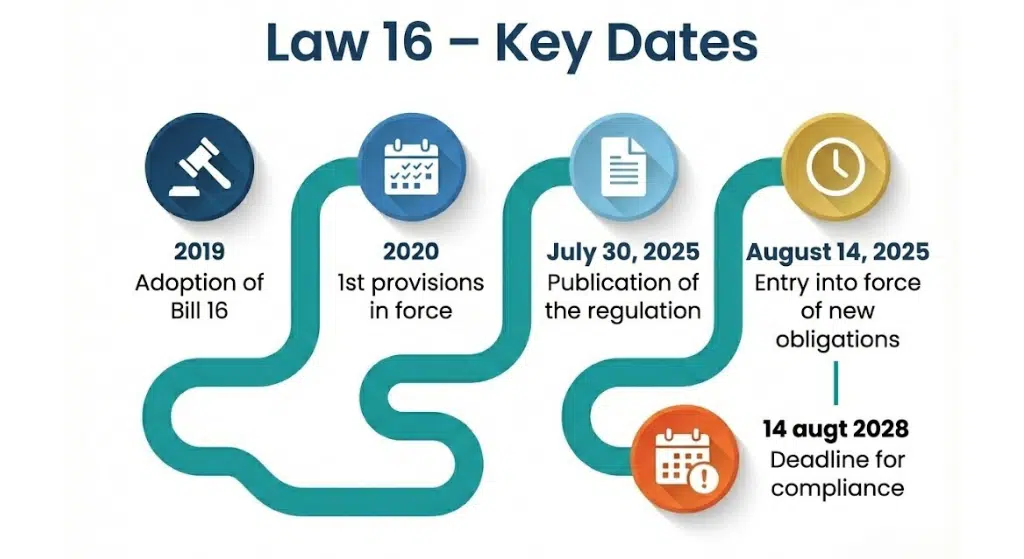
This law, originally adopted in 2019, has been amended multiple times to adapt to evolving needs. Its implementing regulations, finalized on July 30, 2025, officially came into force on August 14, 2025, marking a significant update for stakeholders involved in condo transactions. 

In this guide, I explain the main changes introduced by this new regulation and their implications for buying or selling a condo in Quebec. I explain how to comply with the law and complete a transaction safely, without stress or surprises, helping you feel more confident and in control of your transactions. 

In practice, as a real estate broker, many condominium associations had already begun this transition well before the official effective date. For them, Bill 16 represents a logical next step that clarifies the rules of good governance and strengthens transparency for condo buyers.

Curious about other new regulations affecting Quebec property owners? Read our guide on pool compliance rules 2025.

What is Bill 16? What changes for undivided co-ownership in Quebec?

Context and objectives

Adopted in 2019, Bill 16 aims to strengthen the rules governing undivided co-ownership: 

  • Regulate building maintenance by requiring a maintenance log and its regular updating. 
  • Strengthen the financial management of undivided co-ownerships by examining the reserve fund.

Improve transparency and define the disclosure obligations of sellers and co-owners’ associations, highlighting the legal and financial risks of non-compliance for stakeholders. 

  • Protect buyers by giving them access to standardized, complete, and verified information.

However, it was only on August 14, 2025, with the coming into force of its implementing regulations, that these measures became mandatory for all co-owners’ associations, requiring immediate adjustments in management practices. 

It applies to all undivided co-ownerships in Quebec, regardless of their size or age.

Key Compliance Deadlines – Bill 16 (Divided Co-ownership)

New obligations for homeowners' associations and co-owners

Requirement Effective Date Compliance Deadline Notes / Implications
Syndicate Certificate (ASEC) August 14, 2025 Immediate — mandatory for all sales as of this date Must be provided to the buyer during any transaction; required for all divided co-ownerships.
Maintenance Log August 14, 2025 August 14, 2028 Must include building data, completed work, and inspection schedules; promotes transparency and long-term planning.
Reserve Fund Study August 14, 2025 August 14, 2028 Must be conducted by a qualified professional; update required every 5 years to ensure the financial health of the co-ownership.

Transition Schedule 2025-2028: What Buyers and Sellers Need to Know

Why a Transition Schedule? 

Bill 16 will officially come into force on August 14, 2025, and certain obligations will apply immediately. Highlighting these deadlines helps buyers and sellers feel assured about the clarity and importance of upcoming requirements, fostering confidence in the transition process. 

Starting August 14, 2025, the Certificate of Property Status (CEPP) becomes mandatory for all condominium sales, and no transaction can proceed without it being submitted to the notary, making it a critical compliance document. 

Between 2025 and 2028, condominium associations have a three-year window to complete key upgrades, including the maintenance log, pension fund study, and technical updates, which are vital for compliance. 

Unions have a maximum of three years, until August 14, 2028, to complete: 

  • The maintenance log. 
  • The pension fund study. 
  • The mandatory technical updates. 

Infographic showing Quebec Bill 16 compliance timeline: ASEC mandatory 2025, Maintenance Log and Reserve Fund Study due 2028.

Effective August 14, 2028 

All condominiums in Quebec must be fully compliant with regulations and keep their documents up to date according to the prescribed schedule (every 5 or 10 years, depending on the building’s size). 

Understanding this timeline is crucial for stakeholders to avoid transaction delays, as non-compliance after 2028 may affect insurance, mortgage financing, or sales. 

Pillar 1: Attestation on the State of the Co-Ownership (ASEC): “Your legal passport to your condo.”

What the law Says 

Article 1068.1 of the Civil Code of Québec: “Anyone selling a unit must, as soon as possible, provide the prospective buyer with a certificate of status from the condominium association, the form and content of which are determined by government regulation. To this end, the association must provide this certificate to any co-owner who requests it within 15 days.” 

Gros plan sur l'Attestation du Syndicat (ASEC), document obligatoire pour la vente de condos au Québec dès août 2025.

What is the Attestation on the State of the Co-Ownership (ASEC) and why is it important? 

The Attestation on the State of the Co-Ownership (ASEC) is an official document prepared and validated by the condominium association. It provides all the essential information a buyer needs to make an informed decision before purchasing a condominium unit. 

  • The ASEC summarizes essential financial, legal, and technical information. 
  • The certificate presents the current state of the condominium and offers short- and medium-term projections regarding its overall condition. 

Mandatory Content of the ASEC (Legal Obligations) 

The minimum content of the ASEC is defined by the bylaws (Article 10). 

The bylaws authorize the condominium association to provide additional information, either on its own initiative or at the request of the selling co-owner, to present a more complete picture of the condominium. 

The bylaws stipulate four main categories of information: 

1 – Financial Information 

  • The total amount of the reserve fund as of the date of the certificate. 
  • The recommendations of the reserve fund study as of that date regarding the amount that should be available in this fund at the beginning of the current fiscal year. 
  • The total amount of everyday expenses charged to the co-owners by the management council over the past 3 years. 
  • The total amount of cash available for the payment of the condominium’s current expenses. 
  • The positive or negative balance shown in the condominium’s last three financial statements. 
  • The projected budget for the current year. 

2- Insurance and Guarantees 

  • Confirmation that the condominium association subscribes, in accordance with Article 1073 of the Civil Code of Québec, to all mandatory insurance policies. 
  • Total amount of the self-insurance fund as of the date of this certificate. 
  • Amount of the highest deductible stipulated in the insurance policies subscribed to by the condominium association. 
  • Summary of claims affecting the private portion being sold or the common areas of the building. 

3- Condition of the Building and its Management 

  • Inspections and assessments carried out at the initiative of the condominium association during the last five years, concerning the general condition of the building or one of its main components. 
  • Major repair and replacement work is planned for the common areas during the next ten years. 
  • Cost and schedule estimate for this work. 

4- Condominium Information

  • Ongoing disputes involving the condominium association are subject to legal proceedings 
  • Amendments made to the condominium bylaws in the last 3 years. 

ASEC versus DRCOP:  

What really changes?  

The DRCOP (Request for Information from the Condominium Syndicate) was previously the standard document given to condominium buyers. Bill 16 makes the ASEC mandatory; however, some information is not included in its minimum required content. Clarify the legal obligations for providing these documents to help buyers understand their rights and timelines. 

To address the shortcomings of the certificate’s minimum content, Article 1068.2 of the Civil Code of Québec allows buyers wishing to purchase a condominium to contact the condominium association directly to obtain additional information or documents. Much of this data, particularly that provided by the DRCOP, remains essential for evaluating the condominium. 

Comparison with the DRCOP 

The DRCOP includes the following elements: 

  • Arrears in everyday expenses, allowing you to determine if any outstanding debts affect the condo for sale. 
  • Special assessments voted on but not yet due. 
  • Disputes related to the unit being sold. 
  • The condominium association’s registration number. 
  • Additional fees related to the use of a restricted-use common area. 
  • Work carried out in the private unit without the condominium association’s authorization. 

The DRCOP complements the ASEC and requesting both documents helps buyers and sellers feel assured about the condo’s details. 

Practical Advice If You Are Selling Your Condo 

Request the Certificate of Co-ownership (CCP) early to give sellers a sense of control and preparedness in the sale process. 

  • Don’t wait for an offer to purchase to be accepted. 
  • Avoid negotiation delays due to the 15-day legal notice period required by the condominium corporation. 

“1068.1. The person who sells […] To this end, the condominium corporation provides the certificate to the co-owner who requests it. […]” Obtaining the CCP is open to everyone. The text does not limit access to this document to co-owners who have listed their condo for sale. Therefore, any co-owner can request it at any time, even without an immediate plan to sell. Clarify the process and timing for requesting these documents to help buyers and sellers plan accordingly. 

Thus, a forward-thinking co-owner who wants to avoid being caught off guard when required to provide the CCP can obtain it in advance. 

“1068.1. Every person selling a unit must, within a reasonable time, provide the prospective buyer with […].” 

The phrase “within a reasonable time” is not defined by law. However, it appears that the obligation to provide the certificate arises upon acceptance of an offer to purchase, even a conditional one. 

The condominium corporation has 15 days to provide the certificate when a co-owner requests it. This means that if the seller did not ask for the certificate before putting their unit up for sale, the deadlines stipulated in the offer to purchase for receiving and reviewing the documents must take this into account. 

Preparing your documents early is just one part of the process. Read our full Strategic Guide for Home Sellers to maximize your sale price.

Practical Tips for Buying a Condo 

Carefully review all documents and information provided, such as the CC, CSRR, financial statements, and reserve fund study, to feel confident in your understanding of the condo. 

  • Monitor for deficits, special assessments, announced major work, and disputes. 
  • Request an up-to-date CC if the time between the acceptance of the offer and the date the CC was issued is too long. 

“1068.1. The seller of a dwelling must, as soon as possible, provide the prospective buyer with a certificate from the condominium corporation regarding the condition of the condominium […].” The CC must be given to the buyer whose offer has been accepted, even if it contains conditions. 

It is not necessary to give it to those who are considering submitting an offer or to those whose offer has been rejected. 

For a step-by-step breakdown of the entire purchasing process, consult my Strategic Guide for Home Buyers.

Pillar 2 — The Maintenance Log — Your Health Plan for the Condominium

What the Law Says

“Article 1070.2 of the Civil Code of Québec: The board of directors shall establish a maintenance log for the building, which describes, in particular, the maintenance performed and to be performed. It shall keep this log up to date and have it reviewed periodically. The form, content, and procedures for keeping and reviewing the maintenance log, as well as the persons authorized to establish and review it, are determined by regulation. The standards established by regulation may vary according to the characteristics of the building.” 

Mandatory Content of the Maintenance Log 

The log must include: 

  • An inventory and description of the building’s common areas, including the materials, appliances, and equipment they contain. 
  • An inventory and description of the materials, appliances, and equipment installed in private units, the maintenance of which is the responsibility of the condominium association. 
  • A dedicated section providing an estimate of the condition and remaining lifespan of these materials, appliances, and equipment. 
  • The major repairs and replacements are planned for each of these items over a minimum period of 25 years. 

MAINTENANCE LOG OBJECTIVES 

  • Record work already completed. 
  • Plan future work. 
  • Help the condominium association establish its budget. 
  • Reduce the risk of unexpected special assessments. 
  • Ensure the long-term viability of the building. 

UPDATING THE MAINTENANCE LOG 

The maintenance log must be updated by the board of directors and verified by a professional member of one of the professional orders listed in the bylaws. 

Deadline for obtaining a maintenance log: August 14, 2028. Meeting this deadline ensures the building remains compliant and avoids potential issues, fostering a sense of security and preparedness among stakeholders.” 

SMALL CONDOMINIUM BUILDINGS: Relief on the Horizon 

Good news for small condominium buildings: 

  • If your building has eight units or fewer, or no more than two stories (for example, a triplex or a fourplex).
  • Professional verification of the maintenance log is required only every 10 years, instead of every 5 years. 
  • This significantly reduces the financial burden on condominium associations. 

Points to check in the maintenance log for any buyer

Requirement Effective Date Compliance Deadline Notes / Implications
Syndicate Certificate (ASEC) August 14, 2025 Immediate – mandatory for all sales from this date onward Must be provided to the buyer during any transaction; required for all divided co-ownerships.
Maintenance Logbook August 14, 2025 August 14, 2028 Must include building data, completed work, and the inspection schedule; improves transparency and long-term planning.
Reserve Fund Study August 14, 2025 August 14, 2028 Must be conducted by a qualified professional; required to be updated every 5 years to ensure the co-ownership’s financial health.

Pillar 3 — Reserve Fund Study — No More Unforeseen Expenses

Legal Basis 

“Article 1071 of the Civil Code of Québec […] The board of directors must commission a study of the reserve fund to determine the amounts needed to ensure that the fund is sufficient to cover the estimated cost of major repairs and the replacement of common areas. This study must be conducted in accordance with the standards established by government regulation, which designates the professional orders whose members are authorized to conduct these studies and determines the frequency with which the board of directors must obtain a new study. These standards may vary depending on the building’s characteristics. […]” 

Who can conduct the study?  

Recognizing qualified professionals like engineers, architects, and accountants reassures owners about the study’s credibility and thoroughness. 

It is essential to distinguish between the different types of recognized experts: 

  • For the maintenance log, which consists of a technical analysis of the building, the recommended professionals are: 
  • Engineers 
  • Architects 
  • Professional technologists 
  • These building experts will assess the building’s physical condition and the lifespan of its components. 
  • For the pension fund study, which consists of a financial analysis, the recommended professionals are: 
  • Engineers, architects, and technologists 
  • But also chartered professional accountants 

This study combines the data from the maintenance log with financial projections. 

Mandatory Content of the Reserve Fund Study 

The reserve fund study must include a realistic projection for the next 25 years: 

  • An estimate of the cost of each major repair and replacement of common areas planned over the next 25 years. 
  • It must also include recommendations regarding annual contributions, based on the amount 
  • That must be available in the reserve fund at the beginning of each year. 
  • And a method for correcting any funding shortfall by assessing the amounts to be paid annually to ensure that the reserve fund is sufficient to cover future expenses. 

Why is the reserve fund study critical?  

Its objectives help the condominium plan confidently for future repairs, fostering financial stability and property value. 

“Article 154. If the reserve fund study provided for in Article 1071 of the Civil Code, transposed by paragraph 3 of Article 39 of this law, reveals that the fund is insufficient to cover the estimated cost of major repairs and the cost of replacing common areas, the management committee must set the amounts to be paid annually into this fund so that it remains sufficient for a period not exceeding ten years from the date of obtaining the initial study.” 

The study, therefore, allows us to: 

  • Determine the amounts to be paid into the reserve fund to ensure the financial viability of the condominium. 
  • Avoid exceptional and unforeseen calls for funds by allowing the condominium association to have sufficient funds to cover the estimated cost of major repairs and the replacement of common areas. 
  • Preserve the resale value of the apartments. 
  • To allow buyers to have a clear and transparent view of the condition of the apartment they wish to purchase. 

When will a professional reserve fund study become mandatory? 

All condominiums must have a reserve fund study that complies with the standards by August 14, 2028. 

Impact on condominium fees 

Even in small condominiums, a compliant update generally results in: 

  • A gradual increase in monthly fees, 
  • The gradual elimination of exceptional and unforeseen calls for funds, 
  • Greater long-term financial stability for the building, 
  • An increased value for your apartment in the eyes of buyers. 

Pillar 4 — Security Deposits: The New Mandatory Protection for Buyers

Legal basis: Article 1791.1 of the Civil Code of Québec 

“Notwithstanding any agreement to the contrary, any deposit paid to a builder or developer for the purchase of a unit held in joint ownership must be fully protected by one or more of the following means: a warranty plan, insurance, a surety bond, or a deposit in a trust account held by a member of a professional order, in accordance with the terms and conditions set out in the regulations. The deposit may also be protected by any other means provided for in the regulations, in accordance with the terms and conditions set out therein. […]” 

This article marks an important change: deposits can no longer be paid directly to the developer or builder. 

How must deposits be protected? 

Bill 16 requires that all deposits (for a new unit or one under construction) be placed in a trust account. 

Who can manage the trust account? 

This account must be managed by a member of one of the following professional orders: 

  • Quebec Bar Association 
  • Quebec Chamber of Notaries 
  • Quebec Order of Chartered Administrators 
  • Quebec Order of Chartered Professional Accountants 

Neither the developer nor the builder is authorized to receive or manage these funds. 

The buyer must pay their deposit directly to the trustee, never to the developer. 

Why does this measure exist? 

To protect buyers against: 

  • Developer bankruptcy. 
  • Construction delays. 
  • Project abandonment. 
  • Loss or mismanagement of deposits. 

This is one of the most important changes introduced by Bill 16, yet one of the least known to the public. 

What happens if divided co-ownerships don't comply with Law 16? Hidden risks: insurance, financing, and property value

Besides legal recourse, non-compliance with Law 16 can lead to serious financial risks for all co-owners, including the potential loss of property value and access to financing. 

Compromised insurability: 

Insurers are becoming increasingly vigilant. A co-ownership association that cannot provide an up-to-date maintenance log or a compliant reserve fund study could face: 

  • Significantly higher insurance premiums, 
  • Coverage limitations, 
  • Or even a refusal of insurance. 

Mortgage Financing Refusal: 

During a sale, the buyer’s bank can now require a Credit Information Certificate (CIC). 

If this document is missing or if the bank deems the funds insufficient according to the standards of Bill 16, it can: 

  • Refuse to grant the mortgage to the buyer. 
  • The transaction may fall through. 
  • It then becomes tough to sell your condo, except to a cash buyer. 

Impact on Resale Value 

A building held in a non-compliant condominium could: 

  • See the value of its divided shares decrease. 
  • Result in fewer buyers for the shares put up for sale. 
  • See the selling time lengthen when an owner decides to put their share on the market. 

A divided share compliant with Bill 16 sells better, faster, and with less risk for the buyer. 

How to Prepare Now for Bill 16

For Sellers 

  • Request the ASEC certificate early in the process, as it is crucial for verifying compliance and informing your sale or purchase. 
  • Verify the existence of the maintenance log and the reserve fund study. 
  • Inform your real estate broker of any planned repairs or upcoming special assessments. 
  • Keep copies of the minutes from the last three condominium association meetings and the financial statements for the buyer. 

For Buyers 

  • Your offer to purchase should be conditional upon obtaining the ASEC certificate, among other things. 
  • Ask for clarification on any planned work or financing shortfalls. 
  • Consult your real estate broker and notary for a proper interpretation of the certificate. 

Conclusion

Bill 16 marks a significant turning point for the divided co-ownership market in Quebec. It structures, regulates, and brings transparency to a sector that has long needed standardization. With full compliance expected by 2028, co-ownerships that adapt quickly will enjoy a more stable, predictable, and prevention-focused market, giving stakeholders confidence in future transactions. 

Bill 16 is not just a series of obligations; these new rules represent an opportunity for all stakeholders in the transaction: 

For buyers: Purchase with complete peace of mind. Transparency is your greatest asset. Thanks to the ASEC (Assessment of Co-ownership Conditions), the maintenance log, and the reserve fund study, you can now compare buildings based on objective data. These tools help you feel more secure about your investment and estimate long-term costs, reducing the risk of unpleasant surprises after the purchase. 

For sellers, being compliant with Bill 16 is a strategic advantage. Transparent documentation and a solid reserve fund boost buyer confidence, helping you sell faster and avoid negotiations. 

Foire aux Questions

What happens if the study were conducted in 2024?

Studies conducted between August 2023 and August 2025 are valid if performed by a certified professional. They must be updated every five years to maintain validity.

The buyer can request an extension or even cancel the transaction if the document is not provided on time. Without this document, the notary cannot finalize the sale. 

These are collective expenses borne by the condominium association and distributed to co-owners in proportion to their ownership shares, emphasizing the shared responsibility for maintaining the building’s financial health and stability. 

Yes. If a due diligence clause is included in the purchase agreement, the buyer can withdraw if the due diligence reveals a major underfunding issue or upcoming work that will alter the building’s condition. 

The building must be in the process of being brought into compliance. After 2028, the consequences may include:

  • Insurance denial, 
  • Financing denial for buyers, 
  • Decreased resale value. 

New obligations for homeowners' associations and co-owners

Requirement Effective Date Compliance Deadline Notes / Implications
Syndicate Certificate (ASEC) August 14, 2025 Immediate – mandatory for all sales as of this date Must be provided to the buyer during any transaction; required for all divided co-ownerships.
Maintenance Log (Carnet d’entretien) August 14, 2025 August 14, 2028 Must include building data, completed work, and inspection schedules; promotes transparency and long-term planning.
Reserve Fund Study August 14, 2025 August 14, 2028 Must be conducted by a qualified professional; update required every 5 years to ensure the financial health of the co-ownership.

Document Verification Checklist

Document Mandatory for the seller Must be provided to the buyer Verification by the broker
ASEC ✔ Yes ✔ Yes ✔ Detailed analysis
DRCOP ✔ Often required ✔ Recommended ✔ Check for arrears / disputes
Maintenance Log ✔ Yes ✔ On request ✔ Consistency with study
Reserve Fund Study ✔ Yes ✔ Before removing conditions ✔ Financing analysis
Meeting Minutes ✔ Yes ✔ Yes ✔ Detection of major work
Financial Statements ✔ Yes ✔ Yes ✔ Validation of income/expenses
Picture of Dania Fawaz, MBA

Dania Fawaz, MBA

Residential Real Estate Broker

As a licensed real estate broker, Dania Fawaz assists her clients in purchasing and selling houses, condos, or plexes. Her in-depth knowledge of the Montreal and South Shore real estate market, and her personalized approach, will help you find the home of your dreams when she represents you as a buyer, or maximize the full potential of your investment when she protects your interests as a seller.

Dania is a seasoned professional and entrepreneur with over 25 years of experience. She combines practical experience as a co-founder of an innovative company with technical skills in business strategy, sales process management, and negotiation. Her passion for real estate and value creation naturally led her to a career as a real estate broker. She holds an MBA, a DESS, and she is a graduate from INSEEC Paris and UCLA. Dania has always demonstrated communication skills and an ability to effectively inform and influence her audience. Moreover, her numerous presentations bear witness to this. Dania is also a literary influencer for Penguin Random House, Hachette Book Group, and St Martin’s Press.

share this article:

Email
LinkedIn
Facebook
Twitter
WhatsApp