


Foreclosure in Quebec: the complete 2026 guide
When an owner stops paying the mortgage, the lender can take back the property and put it back on the market, either through taking in payment or through a sale under judicial authority. The price sometimes falls below market value, and the sale carries no legal warranty. This guide speaks to both people involved: the buyer weighing the opportunity, and the owner who still has time to act.
Answer within 48 hoursConfidentialNo obligation
The essentials in five points
- The mortgage lender takes back the property after a payment default, then puts it back on the market. The Civil Code of Québec provides two routes: taking in payment (art. 2782) and sale under judicial authority.
- The owner has at least 60 days from the day the prior notice of exercise is registered in the Land Register to remedy the default or surrender the property (art. 2758 C.C.Q.). That is enough time to organize a conventional sale.
- A foreclosure sells without legal warranty. No recourse for latent defects: you budget the inspection, the certificate of location and the renovation reserve before you submit your offer.
- Volume remains low. Quebec recorded 478 prior notices of exercise in July 2026, down from 536 a year earlier. Montreal (+8.0%), the Laurentians (+11.8%) and Laval (+18.9%) are nonetheless rising.
- An owner who sells on their own keeps the remaining equity. In a taking in payment, the debt is extinguished and they receive nothing.
What is a foreclosure?
In Quebec, a foreclosure happens when an owner stops repaying their mortgage loan and the lending institution takes back possession of the property in order to resell it. The law provides two mechanisms: taking in payment, and sale under judicial authority. For a buyer, they have almost nothing in common.
Taking in payment
The mortgage lender becomes the owner of the property in full payment of the debt, which is extinguished (art. 2782 C.C.Q.). The former owner loses the home. They owe that creditor nothing further, and they receive nothing either.
The lender then resells like any other owner: it keeps the profit if the value exceeds the debt, and absorbs the loss if it does not. It therefore chooses this recourse when it believes the property is worth more than what it is owed.
Sale under judicial authority
The lender takes this route when the debt exceeds the value of the property, or when several creditors are claiming their share.
A court then supervises the sale. Among other things, the judgment sets the minimum deposit required with any offer. Expect a longer timeline and stricter rules.
The clock starts when the prior notice of exercise is registered, not at the first missed payment. Article 2758 of the Civil Code of Québec grants 60 days for immovable property: the owner uses that time to remedy the default or to surrender the property. If they do not surrender voluntarily by the deadline, the lender must go to court, which adds several months.
The discount you get is the price of the information you don't have.
The institution selling the home has never lived in itBuying a foreclosed home: advantages and risks
Quebec's foreclosure market stays small. In 2024, there were 21 foreclosure sales in Montreal, 69 in the Montérégie and 43 in the Laurentians. The volumes are modest, but the competition is not: since 2023, rising prices have drawn as many buyers who want to live in these listings as investors.
| What you gain | What you have to manage |
|---|---|
| A price sometimes below market, in exchange for the risk you take on | Sold without legal warranty: no recourse for latent defects |
| Institutional seller: factual negotiation, no emotional stakes | Limited information on the property's history and upkeep |
| Less competition on properties that need renovation | Deferred maintenance, certificate of location often needs redoing |
| Potential equity gain if the work is costed properly | Risk of a bidding war when several buyers target the same property |
| Transaction before a notary, with no public auction, in a taking in payment | Closing deadlines are often tighter than in an ordinary transaction |
| Conditions known in advance in a sale under judicial authority: the judgment sets the minimum deposit required | Sale for unpaid property tax: that one goes through a public auction |
Keep in mind: budget the inspection, the certificate of location and the renovation work before you submit your offer. Once you take possession, those amounts come out of your pocket. My mortgage calculator gives you the monthly payment; add a reserve for the work on top.
How to find a foreclosure on Centris
Centris.ca identifies foreclosed properties on its listing sheets and lets you filter your search to show only those. Most buyers start there. Three other avenues are worth the detour.
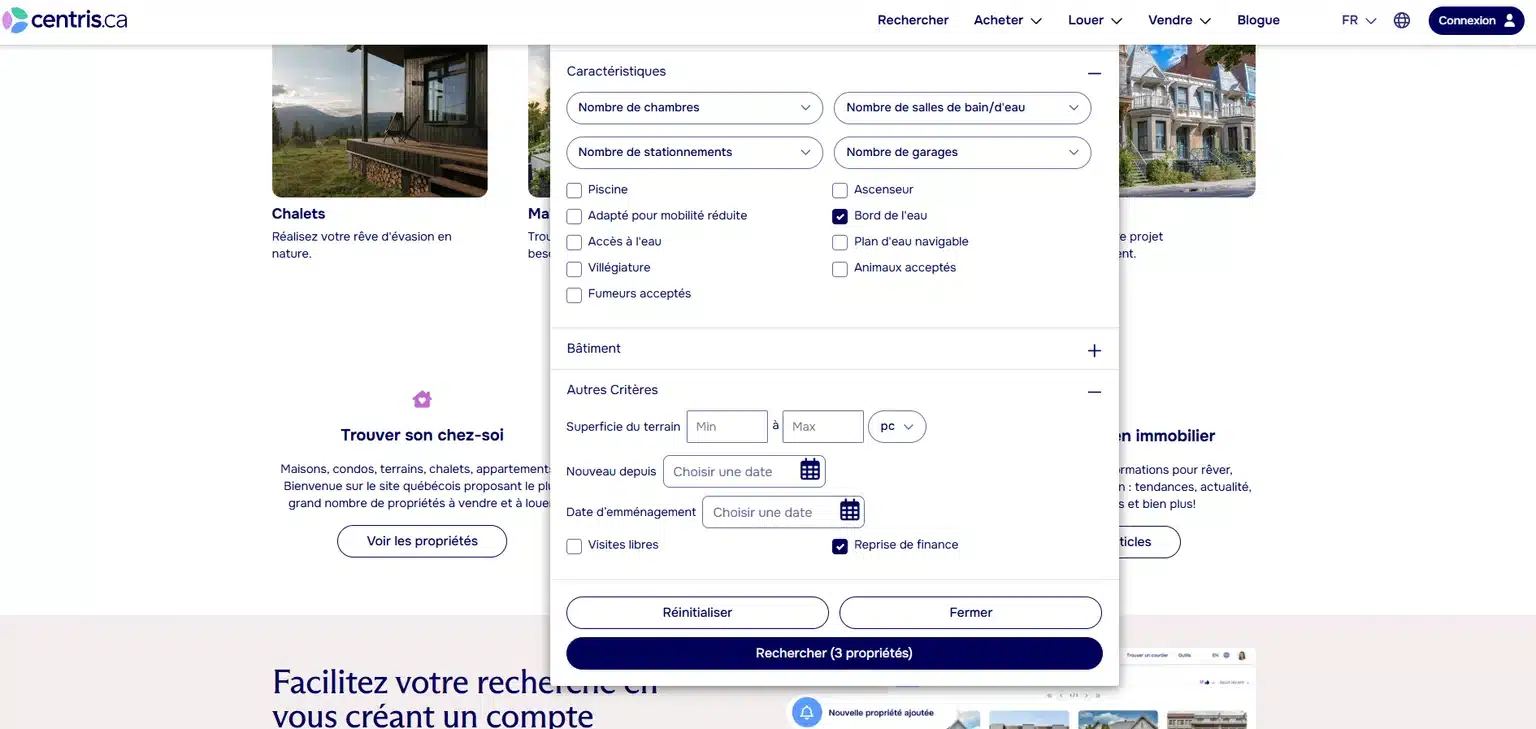
01Filter the advanced search on Centris.ca
In the advanced search, open « Other criteria » and check the « Repossession » sale type.
02Combine it with an area and a property type
Add an area (South Shore, Laval, Montérégie, Laurentians) and a property type on top of the sale filter. The list goes from the whole province down to what you can realistically go and visit.
03Check the lists published by the institutions
Several lenders and real estate banners keep their own list of repossessed properties, separate from Centris listings. Go and look at it on their own site.
04Work with a broker who sees listings the moment they go live
Good foreclosures go fast. A broker sees the listing the moment it is published and can arrange a visit before it starts collecting offers.
Email alertMontreal, South Shore, Laval, MontérégieOne-click unsubscribe
How to buy a foreclosed home, step by step
The first four steps are settled before your first visit. The buyers who land a foreclosure have done this work in advance.
01Real budget and pre-approval
These transactions close quickly. Get your pre-approval before you even start looking, and build in room for the renovations the inspection is going to reveal.
02Work with a real estate broker
A broker used to these files sees new listings earlier and knows how an institutional seller reacts to an offer. A bank does not negotiate the way a private seller does.
03Define your criteria and your tolerance for work
Separate the cosmetic (paint, flooring) from the structural: roof, foundation, electrical, plumbing and ventilation. Decide how far you are willing to go before you start visiting.
04Full due diligence
Have the property inspected by a certified inspector. Check the certificate of location, which often needs to be redone. Then search the land register for legal hypothecs, prior claims and unpaid taxes.
05Negotiate from an informed position
The selling institution works from a floor price and hard numbers. An offer backed by an inspection report and comparable sales in your area lands better than a low offer with nothing behind it.
06Lock in your financing quickly
Deadlines are shorter than in a standard transaction. Warn your lender before you submit the offer so it can act as soon as the promise to purchase is signed.
07Line up home insurance early
Some insurers require an inspection, or impose conditions on a property that has been vacant for months. Call your insurer as soon as your offer is accepted.
08Close at the notary
Read the deed of sale with your notary. The absence of legal warranty must appear in it, along with every condition you negotiated, deadlines and inclusions included.
Buying for the first time? The strategic buyer's guide covers the steps common to any transaction, and the welcome tax refund for first-time buyers applies to a foreclosure too.

How to avoid foreclosure on your home
A late payment does not trigger foreclosure. You still have several months and several options, and most of them leave you with more money than a foreclosure would.
Call a broker or your lender if any of these four signals applies: two or more missed payments, a notice of default or a formal demand letter, municipal taxes unpaid for more than one fiscal year, a refinancing refused by your institution.
No obligation to sellPrivate conversation
01Sell before the taking in payment
This is the option that best protects your equity. In a conventional sale, even one run quickly, you set the price and you negotiate the conditions. Once the loan is repaid, what is left is yours. In a taking in payment, nothing comes back to you. See how a sale unfolds in Montreal and on the South Shore.
02Renegotiate with your lender
Ask for a payment deferral, a refinancing or a staggered repayment agreement. Foreclosure is expensive in legal fees for your lender, and most institutions would rather reach an agreement with you.
03Lighten your other debts to protect the mortgage
A consumer proposal does not stop a mortgage lender's proceedings: the stay of proceedings applies to unsecured creditors, and your lender keeps its right to exercise its security. It can still change the outcome. By suspending your other payments, it often frees up enough cash to resume your mortgage payments, and it blocks creditors who would otherwise have registered a legal hypothec on your property. A Licensed Insolvency Trustee will tell you whether your situation fits.
04Recover your equity while there is still some left
Interest, legal fees and penalties pile up every month you wait, and every dollar of it comes out of your equity. A free, confidential market valuation tells you within 48 hours what a sale would bring in today.
What you keep by selling yourself: you set the price, you choose the conditions, you decide the closing date, and the equity left after the loan is repaid comes back to you. A taking in payment takes all four away.
Interested in a foreclosure?
I watch new listings every day across Greater Montreal, the South Shore and Laval, and I send them to you the moment they go live.
Get foreclosures by emailAt risk of foreclosure on your home?
A confidential conversation, with no obligation. Your property's value within 48 hours.
Free valuationAn owner who sells collects what is left once the loan is repaid. An owner who is foreclosed on collects nothing.
What a taking in payment changes for your finances2026 statistics: Quebec declines, Montreal and Laval climb
The Land Register's financial difficulties index is falling across Quebec: 745 registrations in July 2026, against 785 a year earlier. In my territory, it is going up. Montreal gains 8.0%, the Laurentians 11.8%, Laval 18.9%.
Actual foreclosures, however, remain rare. A prior notice of exercise is not a foreclosure: most defaults are settled through an agreement with the lender, a refinancing or a voluntary sale, without any creditor ever putting the property on the market.
| Indicator | July 2025 | July 2026 | Change |
|---|---|---|---|
| Prior notices of exercise | 536 | 478 | −10.8% |
| Seizures | 49 | 36 | −26.5% |
| Notices of sale for unpaid property tax | 7 | 5 | −28.6% |
| Bankruptcies | 21 | 18 | −14.3% |
| Total index | 785 | 745 | −5.1% |
Swipe the table horizontally on a small screen.
Foreclosure in Montreal, Laval, the Montérégie and the Laurentians
The breakdown by administrative region, for July 2026. Montreal, Laval and the Montérégie, where I practise, account for 359 of the province's 745 registrations.
| Region | Total index | Year-over-year change |
|---|---|---|
| Montreal | 189 | +8.0% |
| Montérégie (South Shore) | 126 | −0.8% |
| Laurentians | 114 | +11.8% |
| Laval | 44 | +18.9% |
| Estrie (Eastern Townships) | 16 | −50.0% |
Swipe the table horizontally on a small screen.
Source: Quebec Land Register, « Real estate market statistics », quebec.ca, updated August 17, 2026. Open data under Creative Commons 4.0 licence via donneesquebec.ca. One caveat: the index groups together instruments of different kinds (prior notices of exercise, bankruptcies, seizures, notices of sale for unpaid property tax, legal construction hypothecs). A prior notice of exercise rarely leads to a sale; most are settled beforehand.
What is your property worth?
I'll send you a free, confidential valuation within 48 hours, based on comparable sales in your area. No obligation to list.
What buyers and owners ask most
Is buying a foreclosure in Quebec a good deal?
On price, sometimes. Provided you budget the inspection, a new certificate of location and a reserve for unforeseen work. With no legal warranty, the bad surprises stay on your side of the ledger: the seller will not reimburse you for anything.
What is the difference between a taking in payment and a sale under judicial authority?
A taking in payment transfers the property to the mortgage lender, which then resells it like any other owner; the debt is extinguished (art. 2782 C.C.Q.). A sale under judicial authority goes through a court, mainly when the debt exceeds the value of the property or when several creditors are claiming their share. There, the judgment sets, among other things, the minimum deposit required with any offer.
How long does the foreclosure process take?
The lender must first register a prior notice of exercise in the Land Register. From that registration, article 2758 of the Civil Code of Québec grants 60 days for immovable property, to remedy the default or surrender the property. If the owner does not surrender voluntarily by the deadline, the lender must go to court, which adds several months. So there is still time to organize a conventional sale.
Can I avoid foreclosure on my house?
In most cases, yes: renegotiate with your lender, or sell the property yourself before the taking in payment. A Licensed Insolvency Trustee can also lighten your other debts to free up the room you need for your mortgage payments. A word of caution: on its own, a consumer proposal does not stop a mortgage lender's recourse. The earlier you act after the first late payment, the more options you have.
Why sell myself rather than let the bank take the house?
Because you pocket the difference. If your house is worth $500,000 and $420,000 is left on the mortgage, a sale leaves you that gap, minus costs. In a taking in payment, the debt is extinguished and you walk away with nothing. You also keep control of the price, the conditions and the closing date.
How do I find foreclosures on Centris?
In the Centris.ca advanced search, open « Other criteria », check the « Repossession » sale type, then add your area and your property type. Several lenders and banners also publish their own list, separate from Centris listings.
Can a foreclosed home be inspected before buying?
Yes, and it is the single most important precaution in the file. Because the property is sold without legal warranty, the inspection is your only protection against a defect no one is going to declare to you. Also plan for an up-to-date certificate of location and a land register search: legal hypothecs, prior claims and unpaid taxes.
Does a foreclosure affect my credit file?
Your lender reports missed payments to the credit bureaus well before the property changes hands. Equifax and TransUnion then set how long those entries stay on file: check your own file with them rather than relying on a general rule. The financial difference, on the other hand, is measurable: a voluntary sale leaves you the equity remaining once the loan is repaid, a taking in payment leaves you nothing.
Is financing harder to get on a foreclosure?
The condition of the building and the timeline weigh more than the nature of the sale. A property that needs major work, or that has sat vacant for months, gives a lender and an insurer alike pause. Since closing deadlines are tighter, warn your lender before you submit the offer.

Dania Fawaz, MBA · real estate broker
As a residential and commercial real estate broker, I work with buyers and sellers in Montreal, on the South Shore, in Laval and across the Montérégie. In a foreclosure file, I deal with two profiles: the buyer who has to put a number on a risk with no legal warranty, and the owner who still has time to take back control of their sale.
The figures in this guide come from the Quebec Land Register and from a compilation I maintain from the real estate brokers' Centris system. The legal points refer to the articles of the Civil Code of Québec cited at the end of the page. This guide is an information document: it replaces neither legal advice nor the guidance of a notary or a Licensed Insolvency Trustee.
- Civil Code of Québec, arts. 1726, 1731, 1733, 2758, 2778 and 2782 · legisquebec.gouv.qc.ca
- Municipal Code of Québec, art. 1022 and following · legisquebec.gouv.qc.ca
- Quebec Land Register, « Real estate market statistics », updated August 17, 2026 · quebec.ca. Open data (CC BY 4.0) via donneesquebec.ca
- CMHC, « Mortgage delinquency rates: Canada, provinces and CMAs » · cmhc-schl.gc.ca
- Centris.ca, « Foreclosed properties now identified on Centris.ca » · centris.ca
- Real estate brokers' Centris system · author's compilation (2024 foreclosure sales: Montreal, Montérégie, Laurentians), current at the time of publication